Text by Kai Koskinen
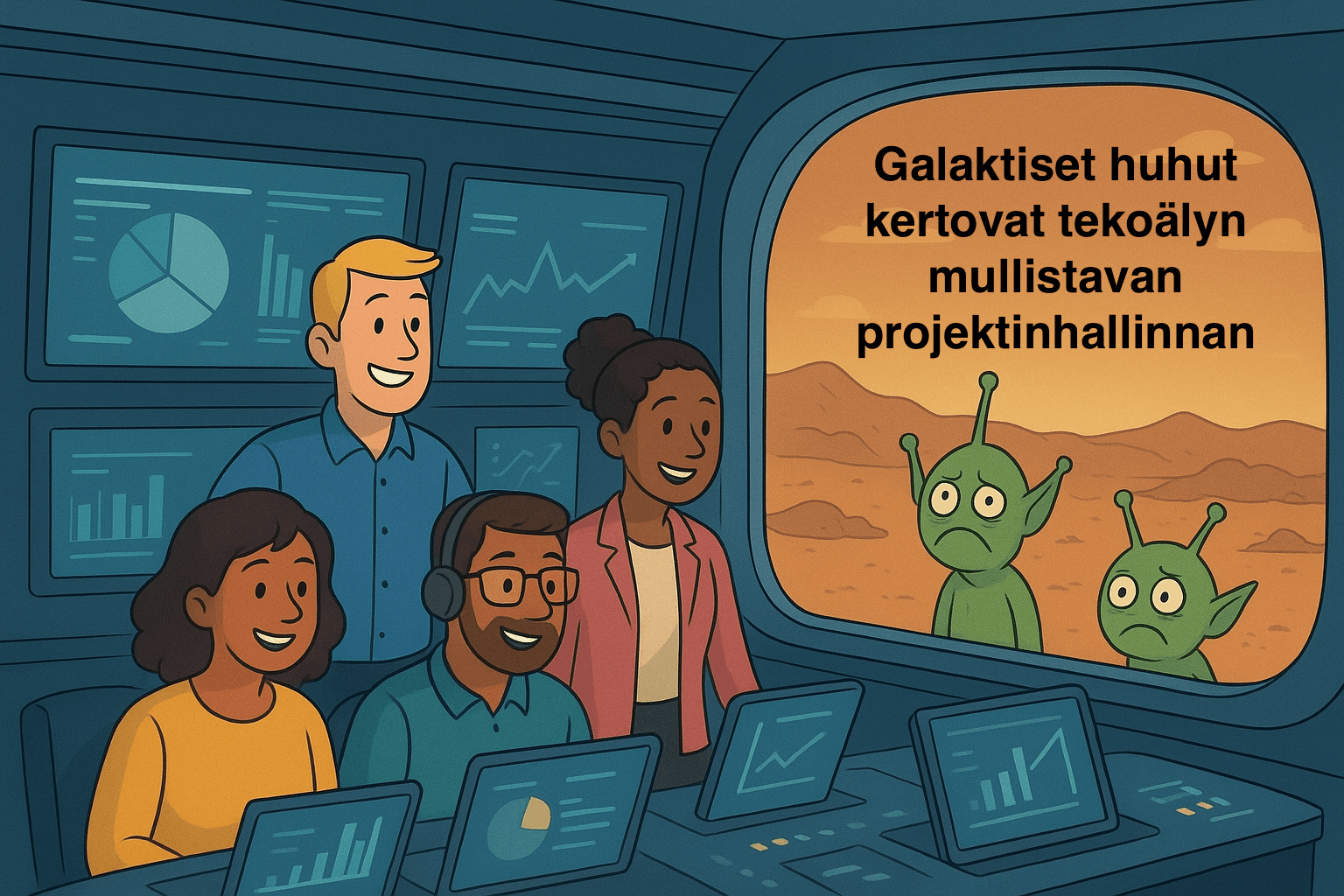
I was delighted to see that the webinar on project management tools that I organised and delivered at the beginning of the autumn, organised by the PRY, attracted quite a large audience; more than 400 participants. Many thanks to the association for the webinar idea. The webinar further spawned this article, which is based on the collection of articles on the Projektjohtaminen.fi website, which can be accessed by registering on the site. More complete comparison tables of software can be found on the site. Further information can also be found on Wikipedia by searching for ‘Comparison of project management software’. Since the paper also deals with the use of AI, I decided to let ChatGPT do the illustrations. This article will focus on foreign examples for now.
On the choice of tools
To support project work, project management almost inevitably needs tools to manage schedules, resources, budgets, risks, monitor project progress and automate routine tasks such as task tracking and reporting.
When choosing a tool, in addition to the purpose, pricing and support, the size and complexity of the project, the size of the project team, integration possibilities with other systems, user-friendliness and security must be taken into account.
Agile tools at your fingertips
Even a simple tool requires a significant investment to implement. The project management issues raised in the surveys often relate to a lack of clarity in communication and objectives, which is why many project management tools focus on workflow management, collaboration and communication. These agile tools can also be very useful in more traditionally managed projects. Examples include Trello, Miro, Slack and Atlassian’s team collaboration tools Jira, Confluence, Loom and Rovo, while timeline management tools with simple interfaces (Gantt charts) includeInstaGantt, GanttProject and ProjectLibre.
Towards more comprehensive project management
For large, constrained projects, a more robust arsenal is naturally needed. Of the software built around traditional project management scheduling and cost management, MS Project, a kind of ‘Metsalem‘ of project tools, will be familiar to almost everyone. Today there are many others, such as ClickUp, Asana, Monday.com and Wrike.
However, the introduction of these tools needs to be carefully planned, as they are many times more laborious to learn than the simple tools mentioned above.
The stakes are rising; portfolio management and simulation
Project portfolio and program management tools such as Planview and ServiceNow are special cases in that they have a perspective that is clearly above the individual project in terms of monitoring the overall project activity, and do not necessarily allow for detailed planning and monitoring of individual projects.
Often based on Monte Carlo modelling, simulation tools are like time machines that allow you to jump into the future: you can run a project with different parameters and find out the probability that the total cost and duration of the project will stay within a certain range; examples include RiskyProject, Full Monte and Oracle Crystal Ball.
Open world
Especially for non-profit or non-profit projects, collaborative open source tools such as OpenProject, GanttProject and Taiga, already mentioned above, can be a very good solution. OpenProject in particular also allows for a wide range of editing options. In addition, at least when installed on your own server, you avoid all operating costs.
The Alliance of Project Manager and Artificial Intelligence
I’m going to stir the pot on this one too. Galactic rumours say AI will revolutionise project management. Gartner predicts that AI will handle 80% of project management tasks by 2030.
To a large extent, it is a matter of performing routine tasks for the time being and using assistants such as ChatGPT mentioned at the beginning or Microsoft Copilot. The comprehensive project tools mentioned above also make extensive use of AI for planning and monitoring.
Will the AI do the work for me or is the AI flawless? The answer to both questions will certainly be no, but it is not worth waiting for the perfect AI to appear. After all, this has never been done before.
Finally
Even in project management, tools are just tools, but at worst they can become a form of discrimination, dividing the project organisation into tool believers and tool haters.