Mona Moisala, a Doctor of Psychology and trainer, gave an insightful and practical talk at Project Days 2025 on promoting mental wellbeing among knowledge workers. Understanding the best ways to support mental well-being improves both wellbeing and productivity at work.
Text by Veera Niemelä, Darling Communications Agency
Photos by Opa Latvala
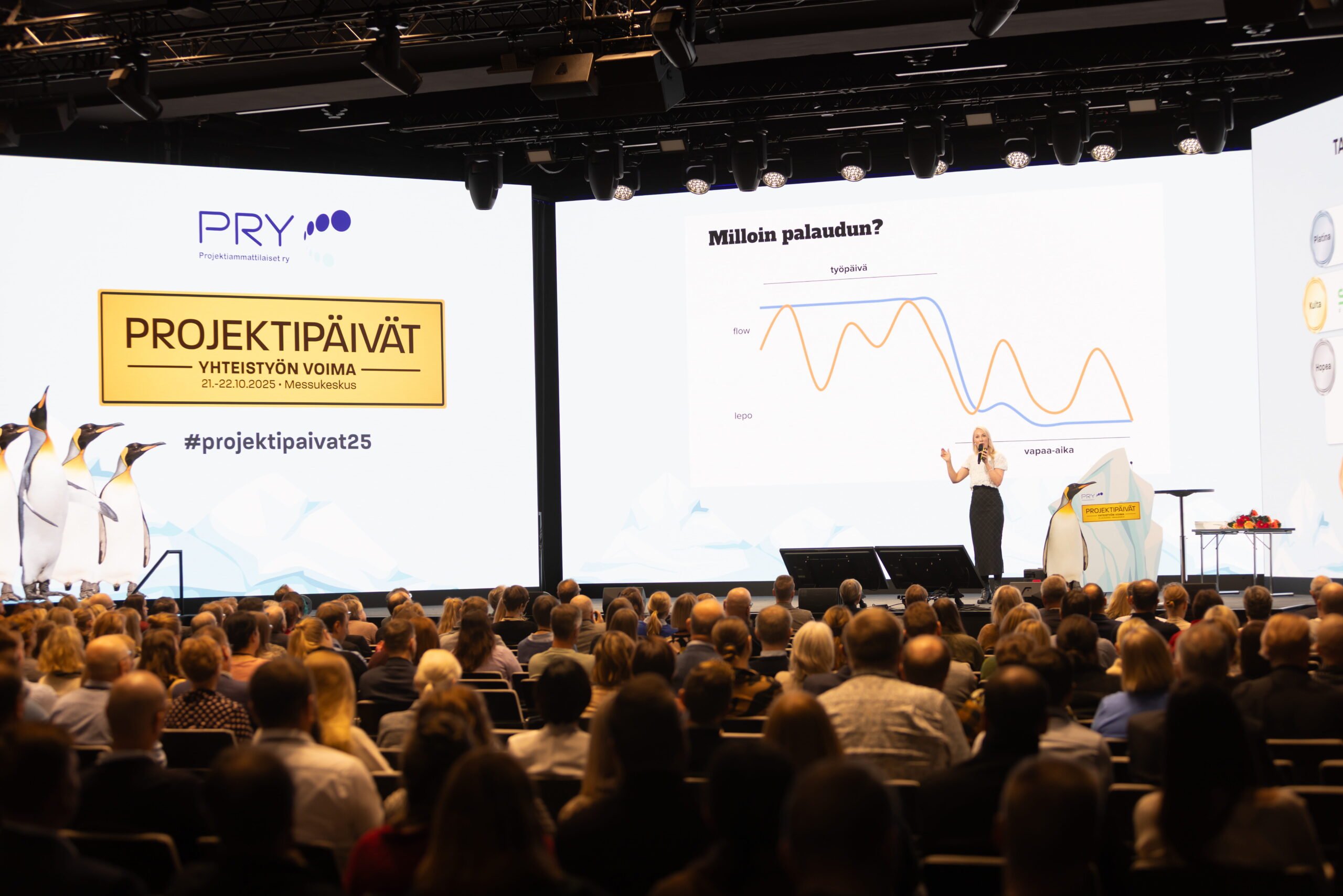
Mona Moisala is a Doctor of Psychology who trains and coaches knowledge workers; her research focuses in particular on brain overload, the effects of technology on the brain, and the ability to concentrate. Moisala developed an interest in how the brain works from a young age.
– When I was at secondary school, I read the book *The Man Who Mistook His Wife for a Hat* by the neurologist Oliver Sacks, in which he describes unusual cases of patients with brain damage. I remember thinking even back then that I knew of nothing more fascinating than the human brain and the inexplicable mysteries surrounding it. That’s why I went on to study neuroscience, he explains
A brain-friendly culture supports an organisation’s success
Moisala sees many positive, sound fundamental principles in Finnish working life: working overtime is not the norm, there is plenty of time for leisure, and management practices and respect for employees are in good shape.
There are downsides, too. According to Moisala, we are still deeply rooted in the belief that the entire working day must be spent working efficiently, and that we mustn’t ‘slack off’ during working hours.
– The same principles apply to intellectual work as to assembly-line work, in that the quality of intellectual work is measured by the volume of output. But in intellectual work, the working day must also include moments to recharge the brain. The brain is not a machine; it cannot concentrate and think effectively for eight hours straight. High-quality intellectual work cannot be measured by the number of emails sent or meetings held; quiet time for reflection is also extremely valuable, he notes.
Throughout his career, Moisala has witnessed progress in making the workplace more brain-friendly. Companies have begun to realise that supporting healthy mental work contributes to the success of the organisation as a whole.
– Employers and line managers can already clearly see that intellectual work needs to be developed in a more sustainable direction, as this also supports work efficiency. A tired or overstimulated brain makes more mistakes, is less productive and fails to generate new ideas. That is why brain health is directly linked to productivity at work, says Moisala.
Concentration and recovery support mental work
Multitasking and interruptions are among the most common obstacles to effective brainwork: it is taxing for the brain to try to do two or more tasks that require concentration at the same time.
– The frontal lobes, in particular, have to work extra hard at such times, and that consumes a huge amount of resources. The same applies to interruptions: it takes a lot of energy for the brain to refocus on what it was doing before the interruption. As a result, we work less efficiently and the quality of our work suffers, says Moisala.
Moisala highlights concentration and recovery as the most important pillars of brain-friendly work. She urges every knowledge worker to pay attention to the role these play in their daily work routine.
– Are there clearly marked blocks of time in your diary when you can focus on thinking tasks without interruptions? Do you notice any completely unnecessary interruptions during your working day that would be easy to cut out? What do you do during your breaks? Do you give your brain a genuine chance to recover, or do you reach for your mobile? Do your meetings always run over time, leaving everyone a bit rushed and having to multitask during them? These are the very first things I’d tackle if a workplace wanted to improve ‘brain ergonomics’, he says.
Project work also requires time to recover at the various stages
The work of a project professional involves time pressure and many moving parts. Some people find working under pressure motivating and energising, whilst for others it may require more effort and mental strain.
– However, one thing that applies to everyone is that, after a particularly intense period of work, it’s important to set aside enough time to recover. When a project reaches a milestone or its conclusion, do we remember to take a moment to breathe and appreciate what we’ve just achieved? This is essential for giving the brain a chance to recharge, Moisala points out.
Things that help recharge your brain include, for example, letting go of work-related thoughts, getting some exercise, chatting to colleagues, or simply doing nothing for a moment.
Smart devices make it hard to concentrate
In an increasingly digital environment, being constantly connected exposes our brains to constant interruptions, which erode our ability to concentrate and leave us stuck in an overstimulated, reactive state.
– It would be really important for everyone to be unreachable for at least an hour during the working day, so that deeper and more relaxed thinking is possible, says Moisala.
For many people, artificial intelligence is already a daily work companion that makes work easier in many ways. Depending on how it is used, it can either hinder or support effective thinking.
– Especially if problem-solving, as well as writing and thinking tasks, are outsourced to artificial intelligence, we’ll be left with more and more menial tasks, such as replying to emails and organising and scheduling work tasks. At its best, AI acts as a catalyst for our own thinking and a mentor, or as a secretary handling the niggly tasks, Moisala notes.
Moisala isn’t about to chuck your phone or other digital devices in the bin. Smart devices can also be used to support your wellbeing.
– For example, apps that limit the time spent browsing social media are really useful; I use one myself. Meditation apps help you to do even short, restorative relaxation exercises throughout the day. With the help of a YouTube video, you can even do a quick exercise break during the day, says Moisala.
Brain-friendly habits take root through the power of example
Brain-friendly working practices are the responsibility of the organisation, line managers and employees alike.
– An individual employee often has only limited influence over their own work, so a line manager must also lead in accordance with brain-friendly principles. For example, they can ensure that employees have the opportunity to book quieter periods for deep work in their diaries. The whole organisation, starting with the CEO, works together to create a working culture in which everyone’s personal example matters, says Moisala.
The example set by line managers has a particularly significant impact on the workplace.
– A stressed line manager is unable to lead, so looking after their own mental wellbeing is the top priority for managers. It’s also worth considering whether you’ve openly discussed working practices and shared principles with your staff. For example, are there clear, shared rules regarding availability – in other words, how quickly a response is expected on each communication channel? Being on standby on communication channels ‘just in case’ creates a huge amount of unnecessary interruptions and mental strain, says Moisala.
Find your own ways to boost your brainpower
Moisala encourages everyone to think about the ways of recovering that suit them best. She, too, has developed her own tried-and-tested ways of taking a break.
– I pay a lot of attention to my recovery during the working day, and I track it using a smart ring. I recover best by going for a quick breather in the middle of the working day or dancing to the beat of my favourite song, she explains.
So where should you start if you want to improve your mental performance? Moisala lists three things that every knowledge worker can do to support their brain health.
– Take a mobile-free lunch break to give your brain some quality recovery time. Secondly, check the notification settings on your work computer and mobile: do you really need to be notified of every new email, for example? Thirdly, take five deep breaths right now. This will calm your nerves and allow your brain to take a brief break from work-related thoughts.

Mona Moisala is an expert in brain wellbeing who was awarded a PhD in psychology from the University of Helsinki in the field of brain research in 2017. In her research, she has focused on topics such as brain overload, concentration and the effects of multitasking. She currently gives talks on topics related to brain health in workplaces, schools, parents’ evenings and at various events. Moisala has previously worked as an organisational psychologist and on several research projects at the University of Helsinki, and was a long-standing member of the Young Academy of Sciences. Moisala was awarded the 2025 Mensa Prize for her work.
In early 2025, Moisala published a book entitled*Stupid Working Life – How to Save the Mind of a Knowledge Worker*. The book’s practical proposals for solutions help to create a better and more wellbeing-focused work culture. Its aim is to bring about a genuine transformation of working life and to make thriving knowledge workers one of the driving forces behind Finland’s competitiveness. In addition, Moisala has edited the book*Children, Young People and Smart Devices* (2019) together with Silja Kosola and Päivi Ruokoniemi, and co-authored the book*A Guide to Reviving Concentration* (2018) with Minna Huotilainen.