The City of Turku is developing anew digital app to make it easier to access food aid. This initiative stems from the city’s aim to combat poverty and respond to the changing needs for food aid. The project received funding through an international competition for cities organised by the Bloomberg Philanthropies. The Association of Project Professionals has named the City of Turku’s innovation as the ‘Project of the Year 2026’.
Text by Veera Niemelä, Darling Communications Agency
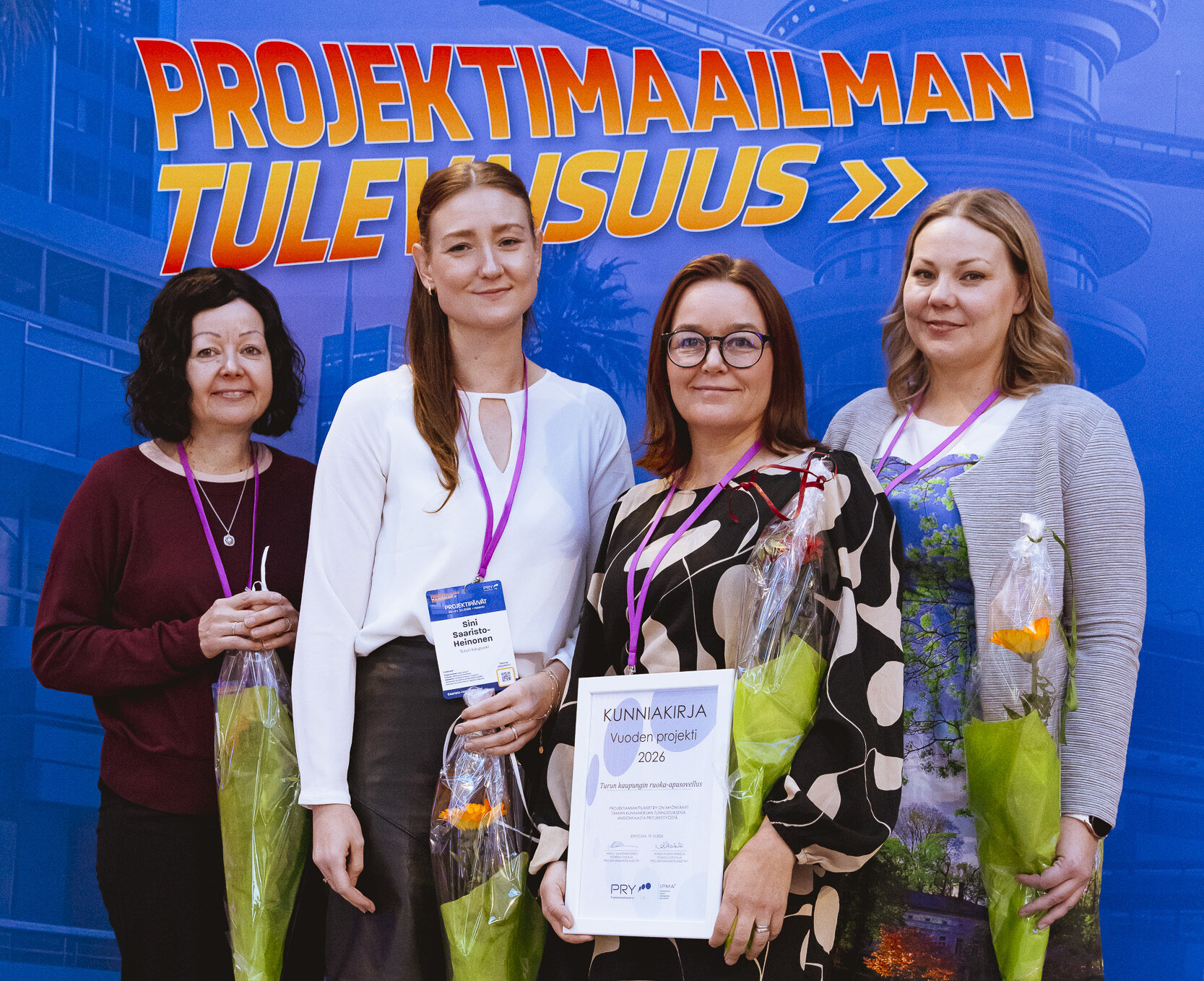
The City of Turku’s food aid app was named ‘Project of the Year’ at the 2026 Project Days. Photo: Roosa-Maria Kauppila
The City of Turku has come up with an exceptional innovation: a mobile app for distributing food aid. Users can book a time to collect their food via the app, thereby avoiding queues. The app is currently under development, and a pilot scheme is due to begin in early 2027. It is due to be fully operational in 2028. The initiative stems from a desire to tackle societal challenges.
– Combating poverty is one of the City of Turku’s strategic objectives. We want to make food aid even more accessible and develop logistics chains so that food can be distributed to people even more effectively. The aim is to tackle poverty amongst families with children in particular, says Niina Haukioja, project manager at the City of Turku.
In Finland, food aid has been distributed in much the same way ever since queues for bread became a familiar sight on the streets during the recession of the 1990s. Recently, the message from the ground has been grim: hunger has returned to the food queues.
– In the post-recession period, food aid has mainly supplemented and made people’s daily lives easier. ‘What is now becoming clear is that people are genuinely short of food, and the amount of money available for food is clearly less than before,’ Haukioja explains.
Turku secured funding in an international competition
The project received funding from a competition organised by the US-based Bloomberg Philanthropies foundation. The foundation distributes funding globally to cities to help them tackle various urban challenges. Turku was the only Nordic city among the 24 cities awarded funding.
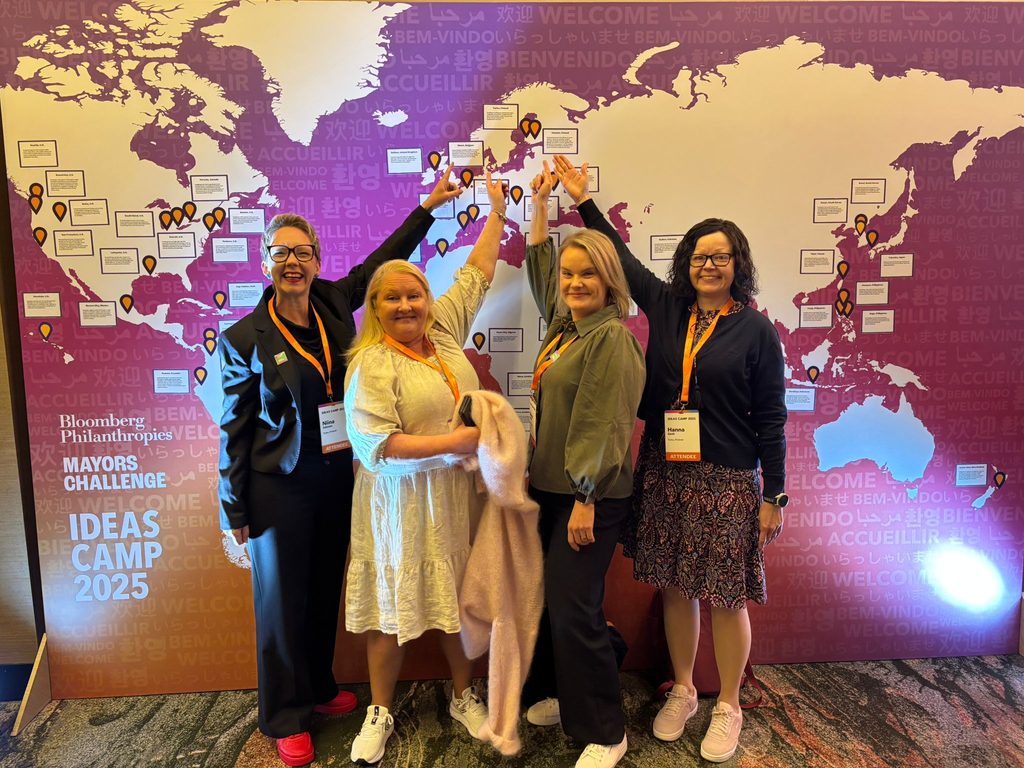
– When the Bloomberg Foundation’s competition was announced in autumn 2024 and we decided to take part, they took an interest in our aim of making food aid more accessible. It was specifically our proposal for a digital solution to food aid that caught the foundation’s attention. ‘In the summer of 2025, we travelled to Colombia to pitch our idea during the final stage of the competition, and we were ultimately awarded funding,’ says Haukioja happily.
Other forms of support alongside food aid
The app is not an end in itself, but one part of the structural development of food aid in Turku. The aim is to create an entirely new digital platform that will enable the smoother distribution of food aid. The app is the part of the platform that is visible to the user.
– Recipients of food aid can choose whether or not to use the app. For example, food aid recipients who are in work may not necessarily have time in their daily lives to queue for food. On the other hand, for some, queuing and eating together is an important social experience that they wish to preserve. The digital platform helps organisations to organise food aid, regardless of whether the recipient uses the app or not. “The platform enables us to ensure that there is enough food at the distribution points, and the data we gather from usage allows us to forecast visitor numbers,” explains Haukioja.
One particular challenge facing food aid is that retailers’ advanced stock management systems have reduced the amount of surplus food. A significant proportion of the food provided through food aid comes from donations from retailers. The amount of food donated is now falling, and it is more difficult than before to predict the quantities. A digital platform helps to target aid even more effectively to where it is most needed.
Haukioja explains that, in addition to its digital aspect, the Bloomberg Foundation was interested in the innovation’s comprehensive nature. As well as providing food aid, the app is also intended to offer other services that are useful to users.
– The city’s own service guidance, such as employment advice, leisure activities and early years education, is set to be integrated into the app. From the outset, we have also been in discussions with the welfare services, which could contribute, for example, outreach social work. Many of the welfare services’ clients make use of food aid, so the benefits would be mutual. Final decisions on the services to be offered will be made based on user needs. As the service is being developed using public funds, we want to ensure that there is a genuine need for the services selected, explains Haukioja.
The digital platform is being designed in collaboration with users
The platform has been developed in response to the wishes of food aid recipients and the organisations providing food aid.
– Turku has an active and extensive network of food organisations, comprising around 15 organisations. They are the platform’s future users. That is why it is particularly important that all solutions are developed in collaboration with service providers, says Haukioja.
In the summer of 2025, during the final stage of the Bloomberg Foundation competition, the project team carried out user research. They interviewed food aid recipients to find out whether they would use a digital service to access food aid, and what form it should take. The user interface, for example, was tested with the recipients. Organisational representatives were also interviewed in the same way.
Urban development stems from the courage to experiment
Funding from the Bloomberg Foundation is specifically aimed at tackling urban challenges. The aim is to identify areas where public administration is not yet functioning as effectively as it could.
The Foundation’s process is longer and more inclusive than the usual funding process. Haukioja praises the thoroughness of the planning process, which enabled a new way of approaching the challenge.
– What was exceptional about this project was the lengthy preparation period, which progressed from the initial idea through a systematic 4–5-month preparation phase to the final evaluation. Usually, funding would be secured first, and only then would the actual development work begin.
During the final stage, the project team received weekly coaching to help them develop their idea. It was through this process, for example, that the idea emerged that a food aid recipient could either book a meal via the app or queue on site, depending on their preference.
– From a project management perspective, it was an interesting process. Normally, one might use a single analytical method, on the basis of which conclusions would be drawn and implementation would proceed. Now, however, the plans were broken down again and again into their constituent parts, and reassembled using different methods and from different perspectives. When the same results began to emerge consistently across different analytical methods, we became increasingly confident that our idea would work, says Haukioja.
It was a positive experience, and Haukioja encourages cities to boldly undertake projects even outside their comfort zone. Urban innovation can improve people’s lives and the functioning of the city as a whole.
– If the city doesn’t change, people won’t change either. Finding new ways of doing things can also save money and make its use more sensible. There are many areas for development that cities and local authorities do not even consider, as they do not fall within the scope of their mandatory activities. What’s been great about this project is the political and administrative courage shown. We’ve learnt a huge amount from this as a team, and we can apply these lessons to our other work too, Haukioja sums up.
The future of food aid is being shaped right now
The project team is currently hard at work developing a digital food aid scheme. The need for this scheme, which is due to be completed in two years’ time, is certainly not diminishing.
– It is difficult to predict the future, but at the moment it looks as though cuts to social security will increase the need for assistance. ‘A new trend is that the proportion of foreign-language-speaking students in food queues has increased in the larger cities,’ says Haukioja.
And could digital food aid be used in other cities in Finland or around the world in the future?
– It could, and the scalability of the solution is also a key objective of the Bloomberg Foundation. There are also opportunities for its use internationally, although it should be noted that there are structural differences between countries in food aid services and social security systems, meaning that beneficiaries and their needs may differ from those in Finland. However, the digital platform can be scaled up for use elsewhere, and its applications are not limited solely to services provided by the city and welfare districts.
The City of Turku’s food aid app
The City of Turku is developing a digital platform to support and streamline the distribution of food aid. As part of the project, a mobile app is being developed which food aid recipients can use to book meals. This socially significant project will be recognised as the Project of the Year 2026.
The project received funding from the Bloomberg Mayors Challenge, organised by the US-based Bloomberg Philanthropies foundation. The foundation was established by Michael Bloomberg, the former mayor of New York, and provides funding worldwide to tackle urban challenges.
The theme of the competition was “Transforming city services”. It was launched in autumn 2024, and in early 2026, 24 cities were selected as winners from among 50 finalists. In total, over 630 cities took part in the competition. The City of Turku received one million dollars in funding to implement its project, as well as 200,000 dollars towards staff costs.